
Jelly Run 2048
CASUAL AZUR GAMESCasual
4.81.38K Reviews
- Version
- 1.70.5
- Installs
- 50.00M
- Age Rating
- Everyone
Screenshots
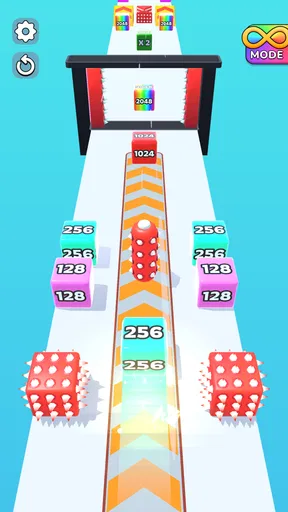
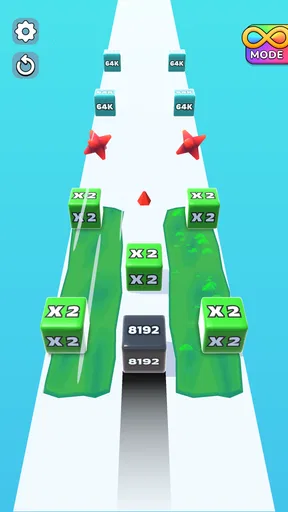
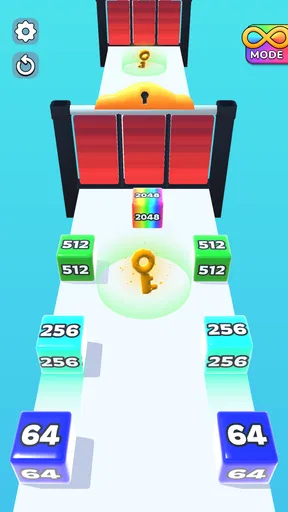
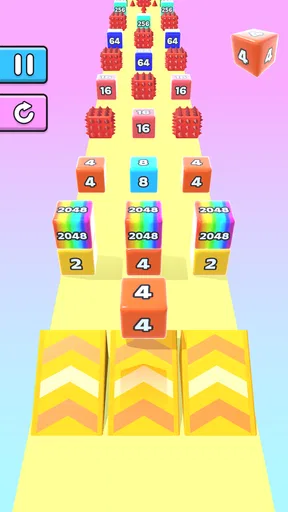
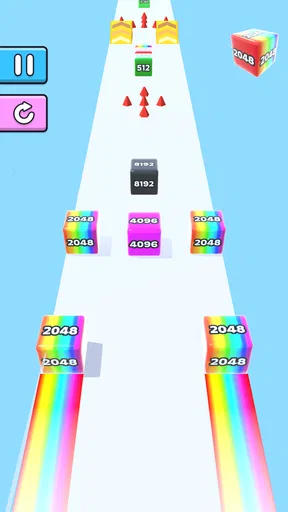
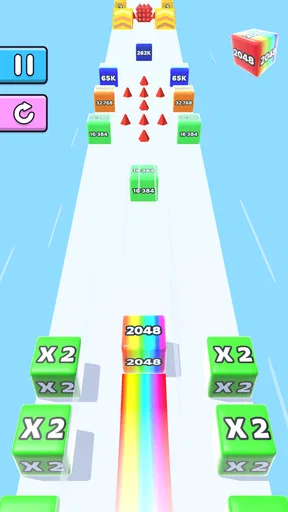

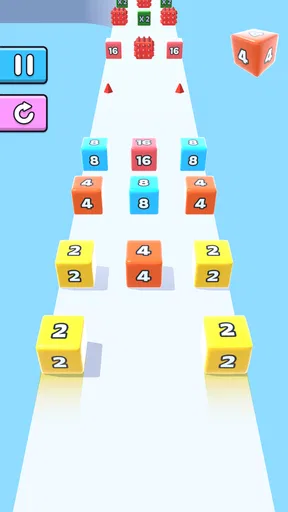
Our Review of Jelly Run 2048
 Analysis by Appyee
I picked up Jelly Run 2048 expecting a quick number puzzle, but its appeal comes from putting that familiar idea into a moving, brightly colored casual game. You guide jelly-like blocks through a course, merge matching values when the opportunity appears, and split them when a larger block would create trouble. The finish line gives each short run a clear purpose, so I am not simply combining pieces without knowing what I am working toward.
That simple goal makes it easy to understand within a few seconds. It also gives the game a different rhythm from a traditional 2048 board, where I can stop and calculate several moves ahead. Here, I have to read the path, react to obstacles and openings, and decide whether growth is actually useful at that moment. The result is a casual game that works well in brief sessions, although players looking for deep strategy or a slow, thoughtful puzzle may find its action-oriented format limiting.
How the early goals make each run feel purposeful
The first useful lesson is that reaching the finish line is not always about making the biggest possible block. A large value can feel like an obvious success in a 2048-style game, but the course changes the priority. I need to think about positioning and timing as much as the number itself. Merging can increase strength, while splitting can give me more flexibility when the path demands a narrower or more manageable shape.
That merge-or-split choice is the central decision I keep returning to. If I merge too quickly, I may create a block that is awkward for the next section. If I split without a clear reason, I can lose the advantage I had built. The game therefore teaches its main idea through play rather than through complicated instructions: numbers matter, but the route determines how valuable they are.
For a new player, the early objective is pleasantly direct. I am not asked to learn a large collection of menus, characters, equipment screens or special abilities before the game becomes enjoyable. I can start a run, understand the basic interaction, and immediately see whether my decision helped. That clarity is one reason the game suits someone who wants a light distraction rather than a long tutorial.
There is also a useful everyday scenario here. I can imagine opening it while waiting for a coffee, taking a few attempts during a commute, or playing one-handed during a short break. The finish-line structure makes it easy to stop after a run instead of feeling forced to commit to a long session. That is a better fit for casual play than games that punish me for leaving halfway through a lengthy level.
At the same time, the early simplicity may not satisfy everyone. Players who want a story, a large collection of characters, or a clear long-term building system will not find those elements to be the reason to play this game. Its initial goal is deliberately narrow: control the jelly block effectively and get it to the end. I see that as focused rather than incomplete, but it does set a firm limit on the type of experience offered.
What counts as progress during play
The strongest progress signal is immediate and visual. A successful merge changes the block in front of me, while a split changes the options available on the track. I do not need to wait for a complicated results screen to understand whether I made a good choice. That instant feedback keeps the game readable, especially when I am playing casually and do not want to memorize a rulebook.
Progress also comes from learning how the course asks me to use the two basic actions. On an early attempt, I may treat every matching opportunity as something to take immediately. After a few runs, I start holding back and looking at the next section first. That shift in judgment is more meaningful than simply repeating the same movement faster. The game rewards recognizing when a number should grow and when flexibility is more important.
I found this especially helpful because the game does not need to bury its appeal under a complicated progression interface. My improvement is visible in the decisions I make. I begin to notice patterns in my own mistakes: merging before checking the route, entering a narrow area with an awkward block, or focusing on a high value while ignoring the finish-line approach. These are small but concrete lessons that make another attempt feel worthwhile.
The wording around unlocks should be approached carefully. The game’s motivation comes primarily from completing runs and handling the merge-and-split challenge better, not from a progression system I would describe as a full role-playing structure. I would not install it expecting a deep collection of permanent upgrades or a long narrative campaign. Its progress signal is the growing confidence that I can read the course and make cleaner choices.
That distinction matters when comparing it with other casual games. Many alternatives use daily rewards, character collections or expanding inventories to create a reason to return. Jelly Run 2048 is more immediate. I return because I want to improve the next run or see whether I can handle a section that previously caught me out. If that kind of self-improvement is satisfying to you, the design works. If you need extensive unlock trees to maintain interest, the motivation may fade sooner.
One practical tip is to treat the first moments of a run as preparation rather than as a race for the highest value. I try to identify the next awkward part of the route before committing to a merge. This reduces the common mistake of making the block stronger but less useful. It is a small change in approach, yet it makes the game feel more strategic without adding any extra controls.
How the difficulty curve affects the pace
The difficulty feels approachable because the basic interaction remains easy to grasp. The challenge comes from applying it under changing conditions, not from learning a long list of commands. That makes the opening inviting for people who enjoy puzzle mechanics but do not usually play demanding games. I can understand what went wrong after a failed attempt, which is important for keeping frustration under control.
As the route becomes less forgiving, the pace changes from casual experimentation to more deliberate planning. I start watching the available space and thinking about whether a split will preserve options for the next move. The pressure is modest compared with an action game, but it is enough to stop the experience from becoming a completely automatic swipe exercise.
The game’s difficulty is best understood as a test of timing and judgment rather than a pure test of arithmetic. A player who knows the familiar 2048 concept may have an advantage in understanding why matching values matter, but that knowledge does not solve the course by itself. The moving format adds a spatial problem: I must use the correct value in the correct place while still advancing toward the finish.
That combination creates a useful trade-off. The game is more lively than a static number grid, but it gives me less time to examine every possibility. If I prefer to calculate a chain of moves at my own pace, a standard 2048 board or another turn-based number puzzle would probably be a better choice. If I enjoy quick decisions and visible movement, this version has more energy.
I also appreciate that the game can be played without requiring a large commitment from the player. A failed run is easy to understand as a failed attempt rather than a major loss of progress. That makes experimentation less intimidating. I can try a different approach to merging or splitting, see how the route responds, and restart mentally with a better plan instead of feeling that one mistake has ruined a long session.
Still, the pacing will not be equally appealing to everyone. Players who dislike repetition may feel that the core action settles into a familiar pattern after the novelty wears off. The game’s strength is refinement: I improve by making better choices within the same central loop. Anyone expecting constant mechanical expansion should keep that in mind before downloading it.
What keeps the game inviting, and what may create pressure
The clearest retention hook is the short-run structure. I can tell myself I will play only once, then make another attempt because the previous mistake feels fixable. That is a healthy kind of casual pull when I use it intentionally: the game gives me a compact challenge rather than demanding a large time investment before anything interesting happens.
The visual change in the jelly blocks also helps the loop feel active. A merge is not just a number adjustment in my head; it changes what I am controlling on the course. Splitting provides the opposite sensation, opening another line of thought when a single large block is no longer convenient. These two actions give the run a simple push-and-pull that is more engaging than only collecting matching pieces.
There is, however, a retention trade-off. Because the main appeal is repeating the course-based puzzle loop, the game may depend heavily on whether I personally enjoy chasing cleaner attempts. It is not the best choice for someone who wants a rich social layer, a story to follow, or a constantly changing set of activities. I would recommend it more confidently to a player who finds satisfaction in small improvements and quick restarts.
The free price makes trying it low-risk, but the presence of in-app purchases means I would still approach spending carefully. Individual purchases range from $0.99 to $26.99, so the game is free to start rather than entirely separate from optional spending. My advice is simple: play enough to decide whether the core loop works for you before considering any purchase. No payment can replace enjoying the merge-and-split mechanic itself.
For parents, the Everyone content rating makes the game approachable for a broad audience. I would still explain the purchase side to younger players, particularly if the device is shared. The game’s casual presentation makes it look harmless and easygoing, but purchase controls are worth checking on any free-to-play title. That is practical advice rather than a criticism of the basic puzzle design.
Another useful way to manage the game is to set a stopping point before starting. Since a near-successful run naturally encourages “one more try,” I sometimes decide in advance that I will stop after a certain number of attempts or after reaching a personal target. This keeps the short-session advantage intact and prevents the retry loop from taking over a break that was meant to remain brief.
Who will enjoy it most, and who should choose something else
I think Jelly Run 2048 is a strong match for players who like casual games with an instantly understandable objective but still want a little judgment involved. It works particularly well for fans of number merging who want movement, for people who enjoy replaying short challenges, and for anyone looking for a colorful time-filler that does not require a complicated setup.
It is also suitable for players who are new to this style of game. The core idea is approachable, and the result of each decision is easy to see. I would feel comfortable suggesting it to a friend who says they want something simple but not completely mindless. The game gives that person a clear first step while leaving room to improve through better timing and route awareness.
I would be more cautious recommending it to someone who wants a deep mathematical puzzle. The familiar 2048 influence is present, but this is not a quiet board game where every move can be analyzed indefinitely. The course changes the emphasis toward spatial control and quick choices. For pure number strategy, a traditional 2048 alternative is likely more satisfying; for a more animated casual experience, this game has the advantage.
Players who dislike optional purchases in free games should also decide whether that model bothers them before investing time. The game can be tried without an upfront price, but the purchase range is wide. I would not treat that as a reason to avoid it automatically, yet I would keep spending separate from the question of whether the gameplay is enjoyable. The free entry point is useful for testing that question.
On supported devices, the technical barrier is modest because the minimum requirement is Android 7.0. The current version is 1.70.5, and the developer is CASUAL AZUR GAMES. Those details make it a practical option for many Android users who do not have a recent flagship phone, although my recommendation still depends more on liking the gameplay loop than on the device requirement.
My verdict on the progression and staying power
After spending time with it, I see the progression as skill-based and session-based rather than built around a large permanent system. The game gives me an early goal that is obvious, progress signals that appear directly in the block and route, and a difficulty curve that asks for better decisions without making the controls intimidating. That is a coherent design for a casual title.
The most important question is whether the merge-or-split choice remains interesting for you after the first few runs. In my case, it does because the two actions create different kinds of risk. A merge promises a stronger block but can reduce flexibility; a split may solve a positioning problem but can weaken the immediate result. That tension gives the finish line more meaning than simply moving forward.
Its limitations are equally clear. The experience is focused, so it does not offer the variety of a larger puzzle collection or the long-term depth of a strategy game. The retry loop can feel repetitive if I am not motivated by improving my own performance. Optional purchases also mean I would keep an eye on spending, especially on a shared device. None of those points cancels the game’s appeal, but they define the audience accurately.
The scale of its audience suggests that the formula has broad appeal: it has passed 50 million installs and holds a 4.8 average from around 209 thousand ratings. Those figures do not replace personal experience, but they fit what I found: a very accessible casual game with a clear hook and enough decision-making to support repeated short sessions.
My final recommendation is to try it if you want a quick, colorful number game that turns 2048-style merging into a route-management challenge. Start by watching the path before making the biggest merge, use splitting as a positioning tool rather than a panic move, and judge the game by whether improving one run feels rewarding. If that small cycle of learning, retrying and reaching the finish keeps you interested, Jelly Run 2048 is an easy game to keep on your phone. If you need deep unlocks, a story, or a completely new activity every session, I would choose a different casual game instead.
Verdict
Strengths of Jelly Run 2048
- Simple swipe controls make it easy to start playing immediately.
- Short levels are convenient for quick gaming sessions.
- Colorful visuals make number progression easy to follow.
- Combining cubes creates satisfying chain reactions.
- Playable offline, making it useful without a data connection.
Limitations of Jelly Run 2048
- Gameplay can become repetitive after extended sessions.
- Later levels may feel difficult without careful planning.
- Ads may interrupt the experience between rounds.
- Limited strategic variety reduces long-term challenge.
- Progress can feel slow when larger numbers are required.
Other Releases by CASUAL AZUR GAMES
View All
Worms Zone .io - Hungry Snake
Action4.3

Stack Ball - Crash Platforms
Arcade4.5

STAR: Super Tricky Amazing Run
Arcade4.2

State.io — Conquer the World
Strategy4.1
Similar Picks in This Category
View All
My Talking Angela
Outfit7 Limited4.2

My Talking Tom
Outfit7 Limited4.3

Pou
Zakeh4.2

My Talking Tom 2: Pet Game
Outfit7 Limited4.3

Candy Crush Saga
King4.6

Bridge Race
Supersonic Studios LTD4.1
Frequently Asked Questions
What is Jelly Run 2048 and how is it played?
Jelly Run 2048 is a casual arcade puzzle game that combines endless running with the number-merging mechanics of 2048. You guide a colorful jelly character or block along a track, collect matching numbered pieces, avoid obstacles, and merge values to create higher numbers. The controls are generally simple, making it easy to start, although reaching high scores requires timing, quick decisions, and careful route selection.
Is Jelly Run 2048 free to download and play?
Jelly Run 2048 is typically available as a free download on mobile devices, allowing players to try the main gameplay without paying upfront. However, the game may include advertisements, optional purchases, or other monetized features depending on the version and platform. Before downloading, it is worth checking the store listing for current pricing, in-app purchase details, and whether certain bonuses or cosmetic items require payment.
Does Jelly Run 2048 require an internet connection?
The core gameplay of Jelly Run 2048 may work without a constant internet connection, which makes it suitable for short sessions while traveling or when mobile data is unavailable. Nevertheless, advertisements, rewards, cloud-related features, updates, and purchase verification may require internet access. Offline availability can also vary between versions, so users should test the game after installation rather than assuming every feature works without connectivity.
Is Jelly Run 2048 suitable for children and casual players?
Jelly Run 2048 is designed around bright visuals, straightforward controls, and short arcade-style rounds, so it can be approachable for children and casual players. The main challenge comes from avoiding obstacles and deciding when to collect or merge numbers. Parents should still review the age rating, advertising content, privacy information, and in-app purchase settings, particularly if the game will be used by younger children.
What are the main advantages and disadvantages of Jelly Run 2048?
The biggest advantages of Jelly Run 2048 are its simple controls, colorful presentation, quick sessions, and combination of running and number-merging gameplay. It offers an accessible way to enjoy puzzle mechanics without long tutorials. On the other hand, the experience may become repetitive after extended play, difficulty can feel dependent on level design, and frequent advertisements or optional purchases may reduce enjoyment for some users. Checking the current store version is recommended before downloading.
Play our best games!


